
Sherman Probation and Parole Compared
Leaving custody does not always end a sentence. In Sherman County, probation is generally imposed by a court as a community sentence or as one part of a judgment. Parole applies to parole-eligible sentences under Oregon Board of Parole and Post-Prison Supervision authority. Post-prison supervision follows prison for many modern Oregon sentences. All three can place a person in the community while rules, reporting duties, and possible sanctions remain in force.
The legal source matters. A Sherman Circuit Court judgment is the best place to confirm probation terms. A final Board action controls parole in a Board case. Oregon Department of Corrections records and the local Community Corrections office help confirm post-prison supervision. A jail release timestamp proves that physical custody ended, but it does not prove that every part of the sentence was discharged.
| Status | How it begins | Best verification source |
|---|---|---|
| Probation | A court orders community supervision in a judgment. | Sherman Circuit Court judgment and Wasco/Sherman Community Corrections |
| Parole | The Oregon Board grants release under a parole-eligible sentence. | Board action, Oregon Offender Search, and the local supervising office |
| Post-prison supervision | A supervision term follows release from an ODOC prison sentence. | ODOC record, judgment, VISOR, and Community Corrections |
- Discharge
- The formal end of custody or supervision, not merely release from a jail or prison building.
- Absconder
- A person alleged to have stopped reporting or left supervision without permission. A missing search result does not prove this status.
- Revocation
- An authority ends community release after a violation finding and may return the person to custody.
Verify Sherman County Release Supervision
Start with a state search, then confirm the result with the office or legal record. The Oregon Offender Search covers people now in ODOC custody or under a local Community Corrections office. A location tied to Community Corrections can mean the person is living outside prison while still supervised. A person who is fully discharged may no longer appear, so no result cannot be read as proof that supervision ended.
- Search by State Identification Number when known. Otherwise, use the full legal name, name variants, and the permitted wildcard.
- Read status and location together. Do not treat a community office as a prison location or a roster absence as discharge.
- Check VISOR for current custody or supervision routing and any registration option tied to the matched person.
- Call Wasco/Sherman Community Corrections with accurate identity details and ask whether that office supervises the person.
- Obtain the Sherman Circuit Court judgment or Board order when the legal start date, end date, or basis for supervision matters.
VISOR is a notification and routing tool, not the official record. Its data may lag, and an offline jail notice calls for direct contact. For a clear history of a former state prisoner, an ODOC Pen Pack or a focused custody and discharge request may contain the face sheet, judgment, public information, photograph, and some parole discharge or violation material. The Sherman County released-inmate search path explains how to pair state data with the jail and court record.
Note: Match identity with a SID, birth details, case number, or other record key before drawing a conclusion from a common name.
Joint Sherman Supervision Office
Sherman County does not operate a separate Moro-only parole office. The county identifies a joint Wasco/Sherman Community Corrections office in The Dalles. It supervises adults on probation, parole, and post-prison supervision. Officers conduct office and community contacts, complete assessments and case plans, arrange testing and referrals, and report to courts or other legal authorities.
This joint structure is a key local detail. A Sherman case can be filed in Moro, a jail stay can occur at NORCOR, and the later supervising office can be in The Dalles. Those are three custodians. Ask the office to verify whether it is the responsible supervising unit and how an authorized person can obtain current reporting guidance. Do not ask the jail to certify a Board discharge or ask the court clerk to state a person’s day-to-day compliance status.
Wasco/Sherman Community Corrections
421 East 7th Street, Annex B
The Dalles, OR 97058
541-506-2758
The county page does not publish a separate public Sherman absconder list. That absence matters. If the person cannot be found in OOS or VISOR, contact the supervising office or review the court and Board record instead of labeling the person an absconder.
Sherman Parole Board Release Records
The Oregon Board hearings page publishes a notice-driven calendar and explains several hearing types. A Prison Term hearing may set a projected parole release date. An Exit Interview may affirm or defer that date. Other proceedings include term reduction, psychological-condition review, murder review, postponement for serious misconduct, older-framework parole hearings, and future disposition after revocation.
A scheduled Board date is prospective. A granted or affirmed date does not prove that a release event was completed. Deferred, postponed, denied, or rescinded outcomes can change the expected path. The person’s final Board action, ODOC custody entry, and Community Corrections status should be read together.
The Board does not provide a public person-name decisions database through its main site. Request a final action through the Board records process. Identify the person, SID, record type, and approximate dates. The Board states that most adult-in-custody records are retained for 25 years and most Board records for 10 years; fees may apply after an invoice.
The official Board hearings screen shows how release questions are routed by case type.
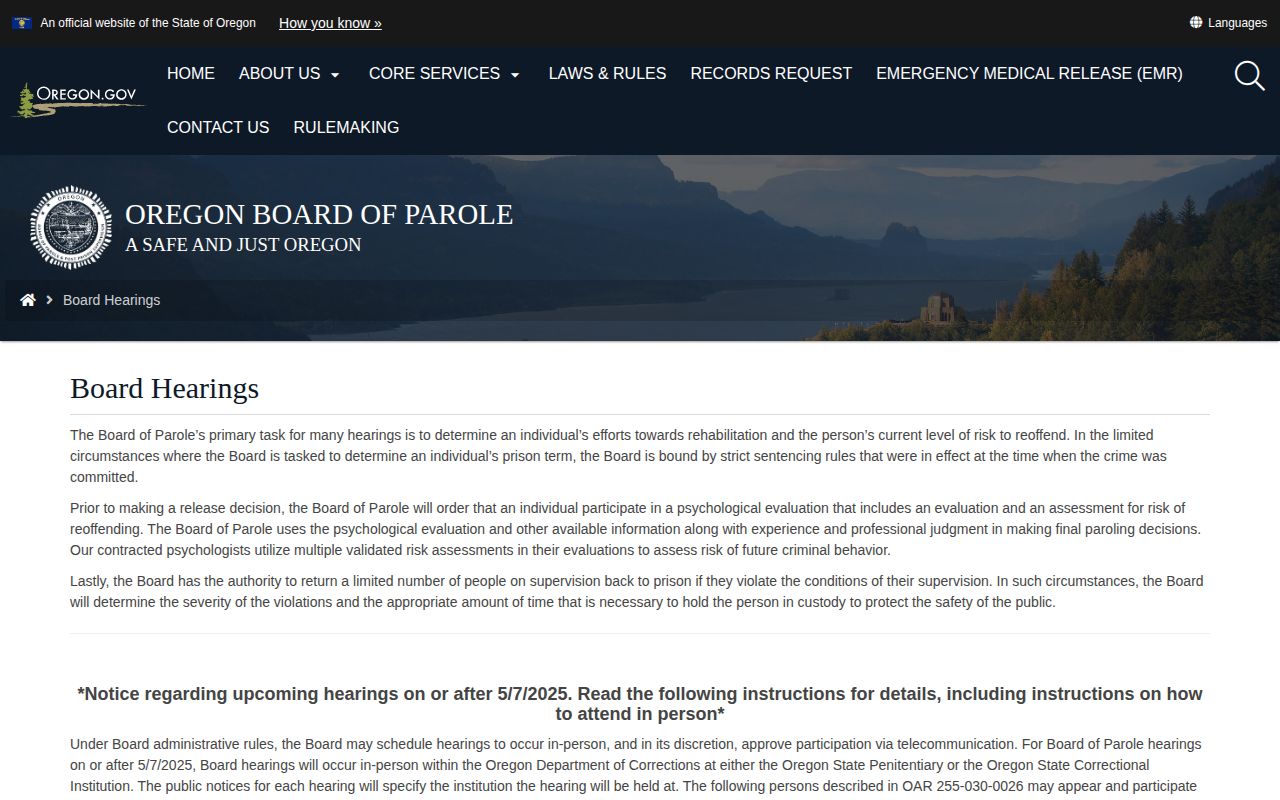
Use the dated notice and final order, not the calendar alone, to establish what the Board decided in a Sherman County parole matter.
Note: Oregon’s older parole statutes chiefly apply to pre-November 1989 crimes and specified murder cases, so eligibility is sentence-specific.
Sherman Supervision Violations and Sanctions
Supervision terms vary by judgment, Board order, and case. At a high level, a person may have reporting duties, testing, treatment, residence limits, travel rules, or other conditions. The local office says its work includes case planning, testing, referrals, and contact in the office and community. A public summary should not be used to guess the exact terms for a named person.
Wasco/Sherman Community Corrections describes graduated sanctions that may include added reporting, community work crew or service, electronic monitoring, or jail. A later NORCOR entry showing a parole violation, probation violation, or post-prison-supervision sanction may reflect a short sanction rather than a new completed sentence. Check the booking charge, court record, supervision record, and any Board action before stating why the person returned.
No hit in a public portal is not a warrant check. A warrant may be held by a court or law-enforcement system that the public supervision search does not expose. Likewise, a missed appointment does not by itself establish absconder status. The responsible officer, court warrant record, or Board action must support that conclusion.
Sherman Supervision Terms and Discharge
Physical release and final discharge are different events. A person can leave NORCOR, finish an ODOC prison term, and still report under probation, parole, or post-prison supervision. Discharge occurs when the proper authority ends that legal status. The most useful proof may be a satisfaction or discharge entry in the court file, an ODOC record, or a final Board order.
ORS 137.633 can reduce some eligible felony or designated-misdemeanor probation and post-prison-supervision terms for compliance and program participation. The reduction may reach 50 percent but cannot shorten the term below six months. The law has major exclusions, including several serious offenses and sentence structures. It changes a possible supervision end date, not the date incarceration ended, and it should never be applied to a person without the judgment and current legal record.
For a formal end date, request the existing order or discharge record. State what the record says and when it was issued. If sources conflict, the most recent final action from the authority that controls the term should lead, while the local office can confirm current routing.
Note: A prison release date, a supervision end date, and a full sentence discharge date may all fall on different days.
Release Property During Sherman Supervision
Supervision planning can begin before a NORCOR release, but the facility’s date may move. NORCOR allows approved release clothing to be delivered up to three days before a scheduled release with supervisor approval. Delivery is handled at the administration lobby desk on weekdays from 8 a.m. to 4 p.m. Staff availability and direct approval still control.
Property release to another person requires the adult in custody to authorize it. NORCOR publishes Tuesday and Friday morning pickup windows from 8 to 11, with identification, approval, delays, and staff access affecting the transaction. The facility separately states limits involving a recipient’s prior NORCOR custody, using a one-year period for money and a 90-day period for property. Those rules should not be blended.
These logistics do not prove release. Coordinate with NORCOR’s money and property office, then use the jail release entry and supervision source to confirm what happened. Release clothing supports a safe transition, while the Community Corrections office supplies the reporting route after physical exit.