
Sherman Release Dates Defined
Four labels can appear in a Sherman County release inquiry. NORCOR uses Scheduled Release on its live current-custody roster. The Oregon Offender Search uses Earliest Release Date for state records, and that field may contain a date or text such as “No Parole.” The Oregon Board of Parole and Post-Prison Supervision uses projected parole release date in certain parole-eligible Board cases. An actual release or discharge date records an event that has already occurred.
These terms are not substitutes for each other. A NORCOR date is an operational forecast for a regional jail stay. The OOS field belongs to an ODOC record. A Board date applies only to the sentence and hearing framework before that Board. Actual release can still be followed by probation, parole, post-prison supervision, community placement, or transfer to another authority.
| Exact label | Source | What it means |
|---|---|---|
| Scheduled Release | NORCOR roster | A prospective county or regional jail date that can change |
| Earliest Release Date | Oregon Offender Search | A state public-record field that is not always a calendar date |
| Projected parole release date | Oregon Parole Board | A future date in an eligible Board case, subject to later action |
| Actual release or discharge | Custody or discharge record | A completed event, with later supervision or transfer still possible |
Find Sherman Projected Release Dates
Begin with the holding authority, not the place of arrest. Sherman County sends adult detainees to NORCOR in The Dalles. A person serving an Oregon prison term belongs in ODOC’s system, even if the conviction arose in Sherman Circuit Court. A federal prisoner requires BOP records. A transfer from NORCOR to another agency is not a community release.
- Check the NORCOR Adults in Custody roster for a person now in regional jail custody. Record the page timestamp and exact Scheduled Release field.
- For an Oregon state prisoner, search the Oregon Offender Search by SID or legal name and read Location, Status, Earliest Release Date, and the offense table together.
- If parole-era Board authority applies, review the Board hearing notice and request the final Board action.
- Read the Sherman Circuit Court judgment to identify the sentence, time-served credit, concurrent or consecutive terms, and later amended orders.
- Ask NORCOR or ODOC for the existing computation or release record when the public date lacks enough detail.
- After the expected day, confirm the actual release entry. Do not infer completion from a person leaving a live roster.
The Sherman County release-record search provides the wider jail, court, state, and transfer path for a named person. A current roster can answer who is listed now. It cannot serve as a permanent archive for someone who left.
Note: A pretrial detainee may have no set date because release can depend on security, court action, dismissal, or transfer.
Sherman OOS Earliest Release Date
OOS covers people currently in ODOC custody or under a local Community Corrections office. It is not a permanent archive of every former Oregon prisoner. A person outside prison but under supervision may remain visible, while a fully discharged person may require a Pen Pack, discharge record, Board order, or judgment.
Search by first, middle, and last name or SID. The official help permits an asterisk wildcard for a partial name. A live result can show its last update, SID, offender name, birth month and year, location, status, physical traits, institution admission date, Earliest Release Date, and an offense table with county, crime, sentence type, begin date, and termination date. The data is updated from time to time and can change.
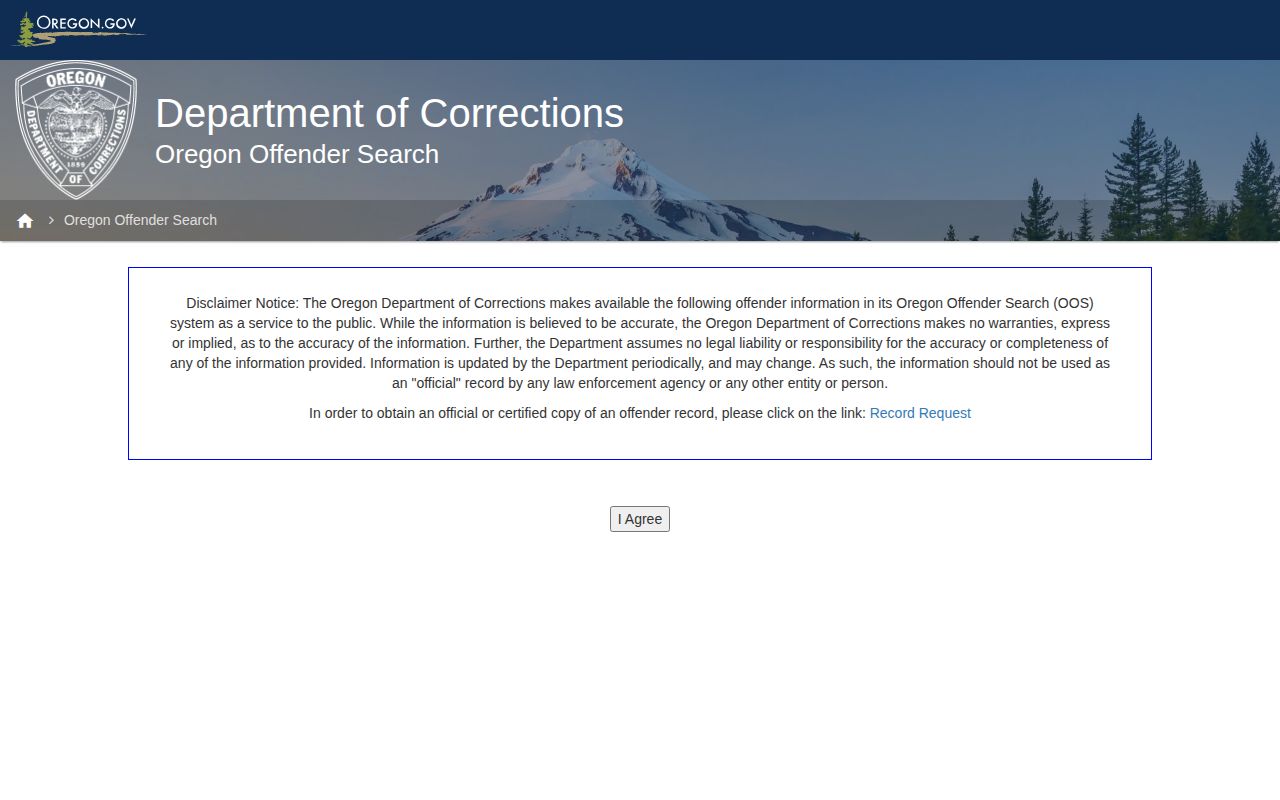
The official Oregon Offender Search screen is the state starting point for a Sherman County prison sentence.
Open the matched SID record and transcribe the field as displayed. Do not rename Earliest Release Date as a jail schedule or a Board parole date.
For an official date record, use the ODOC Public Records Center or mail the request to Oregon Department of Corrections, ATTN: Public Records Request, 3723 Fairview Industrial Drive SE, Suite 200, Salem, OR 97310. Include name, SID, and a date range. Ask for the existing custody, computation, release, discharge, or parole record needed.
Sherman Release Date Earned Time
ORS 421.121 allows qualifying reductions for suitable institutional behavior and participation in adult basic skills for certain felony prison terms involving offenses committed on or after November 1, 1989. The maximum reduction is 20 percent of the total ODOC incarceration term, and it cannot cut actual prison confinement below six months. Statutory exclusions and DOC rules control whether credit is granted, retracted, or restored.
Twenty percent is a ceiling, not a promise. Eligibility can depend on the offense date, sentence law, court findings, exclusions, conduct, and program participation. It is not safe to subtract one fifth from a judgment and publish the result as a Sherman County release date. The agency’s current computation record is stronger than private arithmetic.
NORCOR applies its own local custody computation. The jail says Scheduled Release can change when work or good-time credit is granted or revoked and when the court acts. NORCOR does not publish a universal formula or a public computation worksheet. For a named person, request the calculation and compare it with the Sherman judgment.
No Universal Oregon 85% Rule
Oregon does not require every person to serve about 85 percent of a sentence. The rules are sentence-specific. A qualifying ODOC term may receive earned time under ORS 421.121. In contrast, ORS 137.635 requires certain repeat serious-felony determinate sentences to be served in full without parole, temporary leave, or the cited earned-time deductions. ORS 137.700, often called Measure 11, sets mandatory minimum terms for listed offenses and generally interacts with earned-time exclusions, subject to other statutory mechanisms such as ORS 137.712.
The right question is not “What percentage does Oregon use?” It is “Which sentence statute and computation apply to this person?” Review the judgment, crime date, sentence type, minimum term, eligibility findings, and the agency record. This sentence-level approach also explains why two people with terms that look alike can have different future dates.
This is Sherman County’s distinctive release-date issue: both NORCOR and ODOC can adjust prospective fields for reasons grounded in law or agency credit decisions. A date copied without its source label and observation time loses the context needed to interpret it.
County jail credit and state prison earned time also come from different systems. NORCOR says work or good-time credit can move its Scheduled Release field, but it does not publish one formula for the public to apply. ODOC uses the sentence, statutory eligibility, conduct, and its own computation under state law. A Sherman Circuit Court judgment supplies the imposed term and any stated jail credit. It does not replace either agency’s live computation. Ask for the existing calculation when the date affects travel, a court filing, or release-day planning.
Note: Do not use an assumed percentage to promise a pickup time, court deadline, supervision start, or completed release date.
Why Sherman Release Dates Change
A release forecast is the product of the sentence, credit calculation, court action, and all active holds. A change in one component can move the date or change the destination. Some events delay release. Others can make it earlier. A transfer may remove the person from NORCOR without placing the person in the community.
| Factor | Possible effect | Record to check |
|---|---|---|
| Earned or work credit | May advance a date if the person and term qualify | NORCOR or ODOC computation record |
| Credit loss or restoration | May delay or later restore part of the expected date | Agency credit and disciplinary record |
| Court order | May change the term, credit, release basis, or warrant status | Judgment, amended judgment, or docket order |
| Another agency’s hold | Can cause transfer rather than community release | Jail hold and receiving-agency record |
| Consecutive terms | Can extend custody beyond one case’s apparent end | All controlling judgments and computation |
| Parole Board action | May affirm, defer, postpone, deny, or rescind a projected date | Final Board action |
A detainer is a request or hold from another authority. It can keep a person confined or route a transfer after one sentence ends. That is why a Sherman County roster disappearance does not show where the person went. Confirm the receiving system before describing the event as release.
Sherman Projected Parole Release Date
Board dates belong to limited parole-eligible populations. Oregon’s cited older parole provisions chiefly apply to crimes committed before November 1, 1989, plus murder and aggravated murder cases regardless of crime date. Most modern felony structures use a determinate prison term followed by post-prison supervision, not ordinary discretionary parole.
For eligible cases, a Prison Term hearing can set a projected parole release date. An Exit Interview may affirm or defer it. A misconduct postponement, later Board order, or unexpired nonparolable minimum can affect release. ORS 144.120 includes hearing-timing rules based on term length, but those hearing windows are not a simple release-eligibility formula. ORS 144.397 creates a special path after 15 years for some qualifying youth offenses, with conditions and exceptions that must not be applied to adult cases.
Request the final action from the Board records office when the public notice is not enough. A prospective Board date still needs a completed ODOC custody event before it can be called an actual release. After release, Wasco/Sherman Community Corrections may confirm that local supervision began.
Confirm Sherman County Actual Release
After an expected date passes, check the same custody system again and then contact its records office. For NORCOR, request the actual release date and time, release disposition, scheduled-date changes, charges, holds, and any transfer destination category. For ODOC, ask for the custody and release or discharge record, computation sheet, and relevant parole action. The court judgment supplies the legal basis but may not show the minute of physical exit.
VISOR can send release, transfer, escape, death, and projected-date change alerts for covered Oregon records. An alert is a prompt to verify, not a certified record. The Sherman County VINELink inmate search page explains Oregon’s current VISOR system and the one-person notification workflow.
A two-source check is strongest. Pair a jail release entry with the court judgment for a NORCOR release. Pair an ODOC custody or discharge record with the judgment or Board action for a state release. Record the source label and the time checked, since public data can change.